Iran’s FM says ‘major progress’ made to end Lebanon war as Qatar, Pakistan announce creation of ‘de-confliction cell’; Netanyahu: War created conditions for regime’s fall
By Jacob Magid, Follow
Nava Freiberg, Follow
Agencies and ToI Staff
Today, 4:21 am Updated at 7:05 am

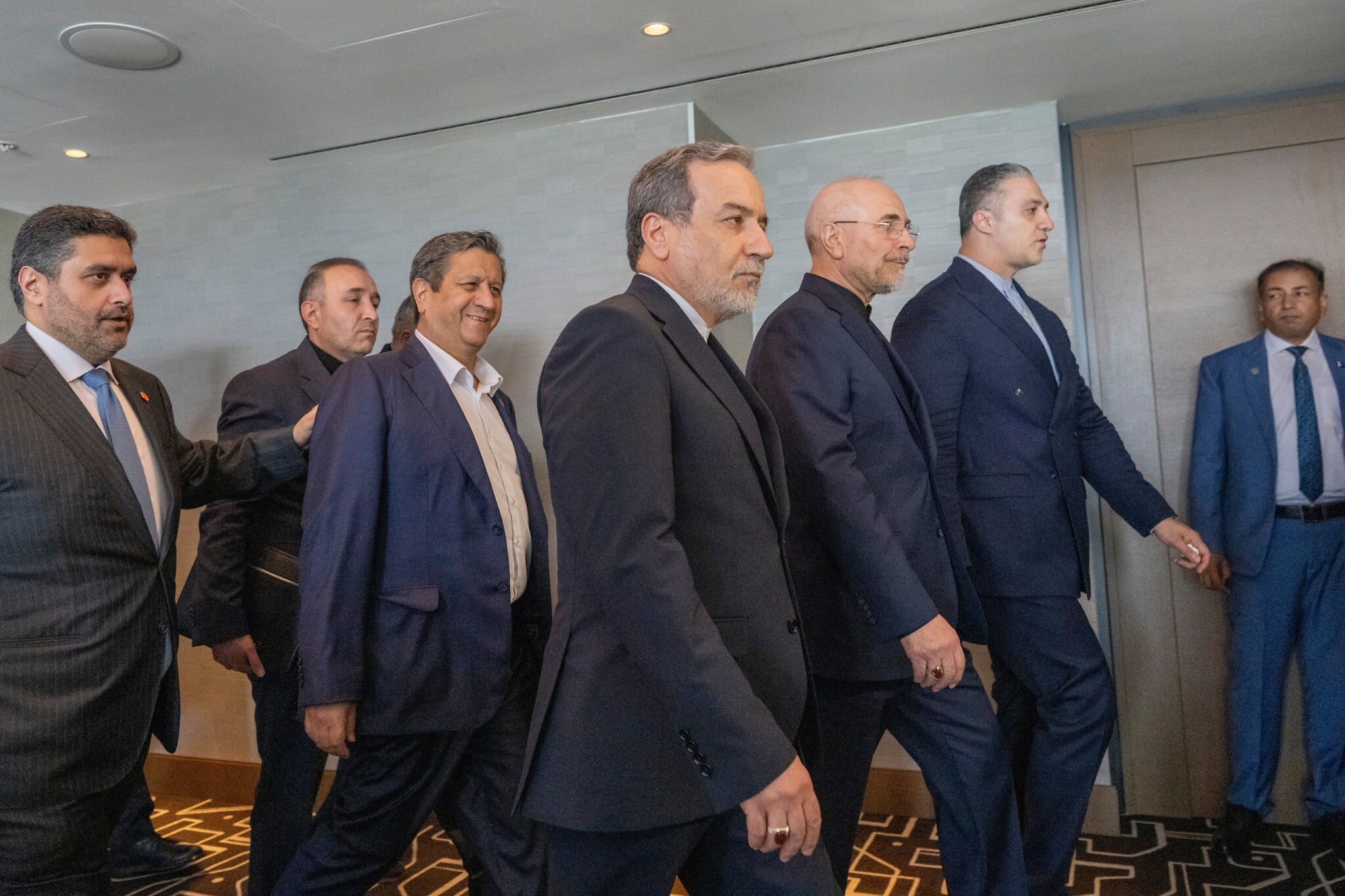
Iranian Foreign Minister Abbas Araghchi, third from right, and Speaker of the Iranian Parliament Mohammed Bagher Ghalibaf, second from right, with the delegation of Iran at the Lake Lucerne Summit at the Buergenstock resort in Switzerland, June 21, 2026. (Urs Flueeler, Pool Photo via AP)
Iran and the United States agreed on a roadmap toward reaching a final deal to end the war within 60 days, mediators Pakistan and Qatar said in a joint statement on Monday following the first day of talks between the sides, as Tehran touted “major progress.”
“The High Level Committee has agreed upon a roadmap towards reaching a final deal within 60 days, laying the foundation for the immediate commencement of further technical talks,” the joint statement from Qatar and Pakistan read, adding that the High-Level Committee was established to oversee the talks. The statement added that talks would continue all week.
The statement came after clashing reports from US and Iranian sources during a rocky first day of negotiations. A senior US diplomat said overnight Sunday-Monday that Iran’s delegation was still present at the Swiss venue where the two countries had held talks, after Iranian state media reported that the team from Tehran had left the site in protest of US President Donald Trump’s repeated threats against the Islamic Republic.
The talks, building off of a memorandum of understanding the two sides signed last week, aim to permanently end the Iran war and reach an agreement on sensitive topics such as Iran’s nuclear program.
Israel, which began the war with Iran in partnership with the US, is not a party to the talks, and the MOU’s terms have caused deep concern among Israeli officials. Iran and the US, meanwhile, have clashed over Israel’s continued conflict with Iran-backed Hezbollah in southern Lebanon, where the MOU calls for a ceasefire.
The mediators’ statement also said that Iran and the United States had agreed to set up a “de-confliction cell” with Lebanon to stop military operations there.
“The parties agreed on the creation of a de-confliction cell, between the parties, the Lebanese Republic and facilitated by the Mediators, to ensure the adherence of the termination of military operations in Lebanon,” the joint statement read. The statement mentioned neither Hezbollah nor Israel.
Commenting after the first day of talks, Iran’s Foreign Minister Abbas Araghchi said there was “major progress” made.
“Pakistani and Qatari mediation has delivered major progress to end Lebanon War,” Araghchi posted on X, saying the establishment of a de-confliction cell in the Lebanon conflict is the “1st real test.”
He noted other areas of progress in the negotiations in Switzerland: “Oil and petrochem exports are waived, blockade lifted, some frozen assets released, and major reconstruction & development plan launched for Iran.”
Conflicting reports from US, Iranian sources
On Sunday, American and Iranian representatives gathered alongside delegations from mediators Pakistan and Qatar at the luxury Swiss resort of Burgenstock. US Vice President JD Vance, who is leading the American team, said that progress had already been made, but shortly afterward, Trump posted on Truth Social, “Iran must immediately stop their highly paid PROXIES in Lebanon from causing trouble.”
He added, “If they don’t, we’ll hit Iran very hard again, just like we did last week, only harder!”
In response, Iran’s chief negotiator Mohammad Bagher Ghalibaf warned the United States against making threats, vowing that “our armed forces are ready to respond.”
“Don’t they think that if their threats had any effect, they would not have reached today’s state of desperation? We do not take American threats into account,” Ghalibaf said after Trump’s post.
“They would do better to be careful with their statements; our armed forces are ready to respond to them in a different manner,” he added. “No matter what they say, we are the ones who act.”
Later, Iranian state media said the country’s delegation left the venue hosting the talks, citing Trump’s post.
“The delegation of the Islamic Republic of Iran, after meeting with the Qatari delegation as one of the mediating parties, left the building where the negotiations were being held,” state news agency IRNA said.
“At the same time as the talks began in Switzerland, Donald Trump published a message on X in which he repeated his threats and remarks against Iran,” it added.

But the senior US diplomat, who was engaged in the negotiations, said talks were in fact proceeding through the night. Iranian state media has reported a series of claims that the US has asserted to be false, and that it says are motivated by a desire to present a harder line to Iran’s domestic audience.
There were some earlier reports of progress in the talks. Footage from Switzerland showed Iran’s Araghchi in the same room with Vance, though the two were not seen interacting. And a member of Iran’s negotiating team said a draft had been finalized regarding sanctions waivers for Iranian oil, adding that the waivers would be issued soon.
But Iranian state television reported that the thorniest issue in the talks, the Islamic Republic’s nuclear program, was not discussed.
“No negotiations regarding Iran’s nuclear program took place during the 80-minute first round of talks,” the state broadcaster said. The US diplomat, by contrast, said negotiators had “robust discussions on all elements of the nuclear deal,” and that they planned to use “today’s work as a starting point for ongoing technical talks going forward.”
Both sides said that they discussed the conflict in Lebanon, highlighting how the talks in Switzerland have become the central venue for discussions regarding Lebanon, even though they do not include Israel, Lebanon or Hezbollah.
“We have also worked through deconfliction mechanisms and enforcing the ceasefire in southern Lebanon,” the US diplomat said.
The US diplomat said discussions have focused on “clarifying some of the confusing messaging from Iran on the Strait and building deconfliction mechanisms to ensure the strait will remain fully open.”
Data shows decline in Hormuz traffic
Iranian state media had claimed that Tehran had closed the strait in response to Israeli actions in Lebanon, while the US has insisted that the channel remains open. Shipping data showed, however, that the number of ships that passed through the strait fell sharply on Sunday.
Five vessels passed the strait on Sunday, compared with 26 ships spotted a day earlier, data from analytics firm Kpler showed. These included three Very Large Crude Carriers carrying 2 million barrels of Saudi crude and fuel oil each, one of which was heading to Japan. The data may exclude vessels that switch off their transponders while travelling in the Gulf.
Tehran’s Islamic Revolutionary Guard Corps on Saturday declared the waterway shut once again in response to Israeli strikes in Lebanon, after opening it under the MOU. The US military said commercial vessels were still operating.
The statement from mediators said the United States and Iran agreed to set up a “communication line” to avoid incidents in the strait.
“A communication line between the parties has been formed… to avoid incidents and miscommunication with the aim of safe passage for commercial vessels through the Strait of Hormuz,” Pakistan and Qatar said.

Netanyahu: We created conditions for fall of Iranian regime
While Israel has been excluded from the negotiations to end the war it began alongside the US, Prime Minister Benjamin Netanyahu made a series of statements reiterating Israel’s position on the war and the peace talks in speeches on Sunday.
The premier, who has distanced himself from the MOU, repeated that Israel is committed to deterring Hezbollah and preventing Iran from obtaining nuclear weapons, and claimed that the war created the conditions for the fall of the Iranian regime, one of the central goals of the US-Israeli campaign.
“With regard to Iran: Whatever diplomatic developments may occur, I will not allow Iran to acquire nuclear weapons. As long as I am prime minister of Israel, that will not happen,” Netanyahu said, speaking in Hebrew at a memorial event marking the 50th anniversary of the death of his brother Yoni Netanyahu, who was killed while leading an elite IDF force in the 1976 Entebbe hostage rescue.
He repeated his assertion that he launched Israel’s campaigns against Iran over the past year “in order to remove the immediate threat of annihilation posed by the evil regime in Iran,” adding, “had we not acted, they would already have had nuclear bombs in their possession, and they would have used them.”
“We have achieved tremendous accomplishments, and we will not relinquish them. We will remain in the security zone in southern Lebanon for as long as necessary in order to protect the precious residents of the north and all the citizens of Israel [from Hezbollah attacks]. As prime minister of Israel, I insist on this unequivocally, and nothing will change it,” he said.

In a separate speech, Netanyahu argued that Israel succeeded in creating the conditions for eventual regime change in Iran, even as the regime emerged intact from the conflict. The Iranian public made no known effort to overthrow their government during the war, which followed a deadly government crackdown that killed thousands after widespread January protests.
While speaking at the JNS International Policy Summit in Jerusalem, Netanyahu listed the military successes of the campaign, saying, “We decapitated the leadership of the terror regime; we shattered their missile industry; we knocked out their navy; we knocked out their air force; we attacked their military industries; we attacked their bridges.”
“The cumulative damage that we did to the Islamic Revolutionary Guards’ economy is… counted in hundreds and hundreds of billions of dollars,” he said.
“It will take them a long time to recover… And they may not recover,” the premier continued. “Because once you deal these blows, and once the rift between the regime and the people is so deep, you cannot tell when such a regime will fall. And I think we created the conditions for its future fall.”
About The Author
