US president says other countries must participate in effort to prevent attacks on shipping; US embassy in Iraq and UAE oil facility targeted by Iran and allies
By Agencies and ToI Staff14 March 2026, 7:47 pm

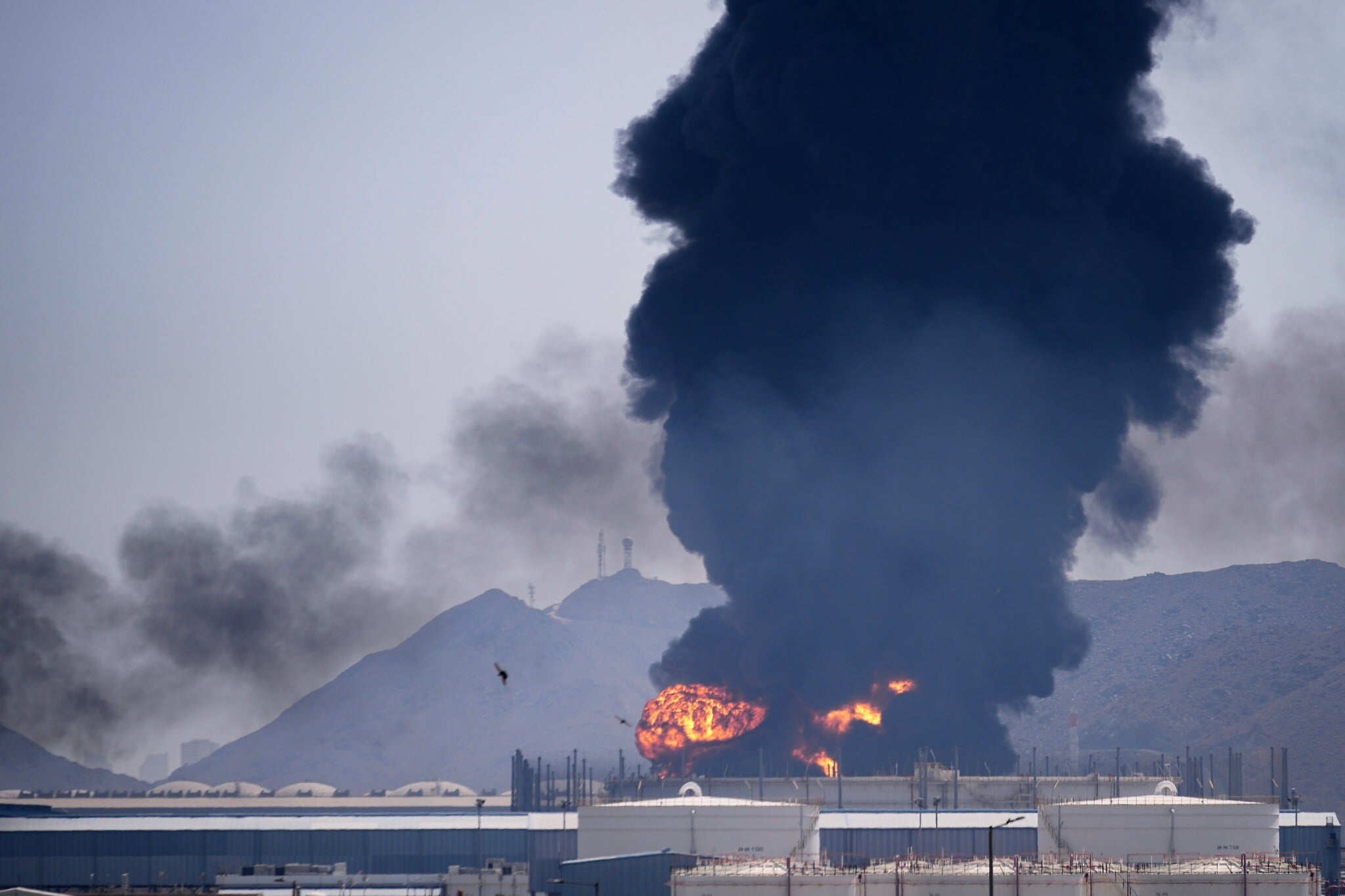
A fire and plume of smoke rise after, according to authorities. debris from an intercepted Iranian drone struck an oil facility in Fujairah, United Arab Emirates, March 14, 2026.(AP Photo/Altaf Qadri)
The US-Israel war with Iran entered its third week on Saturday as a missile struck a helipad inside the US Embassy compound in Baghdad and debris from an intercepted Iranian drone hit an oil facility in the United Arab Emirates, further increasing global anxiety about oil supplies.
Iran has targeted countries across the region and said it would choke off the Strait of Hormuz, a major artery for the world’s oil supply.
In response, US President Donald Trump claimed that “many countries” would send warships to the strait to defend shipping. In a post on Truth Social, Trump then said that “hopefully” China, France, Japan, South Korea, Britain and others would send vessels. It was unclear whether other nations were already confirmed to be sending ships beyond those. He also claimed that “we have already destroyed 100 percent of Iran’s military capability.”
Meanwhile, he warned, the US “will be bombing the hell out of the shoreline” and “one way or the other, we will soon get the Hormuz Strait open, safe and free.”
Later on Saturday Trump said that “countries of the world that receive oil through the Hormuz Strait must take care of that passage, and we will help — a lot! The US will also coordinate with those countries so that everything goes quickly, smoothly, and well.
“This should have always been a team effort, and now it will be — It will bring the World together toward harmony, security, and everlasting peace!” he added.
Iran’s joint military command threatened to attack cities in the UAE, home to Dubai and one of the world’s busiest airports, saying the US used “ports, docks and hideouts” there to launch its overnight strikes on Iran’s Kharg Island, without providing evidence. It called on people to immediately evacuate areas where it said US forces were sheltering, naming Jebel Ali port in Dubai — the Mideast’s busiest — as well as Khalifa port in Abu Dhabi and Fujairah port.
It was the first time Iran has directly threatened non-US assets, in this case commercial ports, in a neighboring country since the war began with US-Israeli strikes on February 28.
Images showed smoke rising over the US Embassy compound in the Iraqi capital and a fire in the UAE’s Fujairah port that broke out after what authorities said was a drone interception.
No one immediately claimed responsibility for the strike on the embassy’s helipad. The embassy complex, one of the largest US diplomatic facilities in the world, has been repeatedly targeted by rockets and drones fired by Iran-aligned militias. There was no immediate comment from the embassy.
Iranian Foreign Minister Abbas Araghchi said on Saturday that Iran would also target the facilities of American companies in the region if its energy facilities are attacked.
“Iran will respond to any attack on its energy facilities,” state television quoted him as saying, after the US attacks on military infrastructure on Iran’s crude oil export hub on Kharg.
“If Iranian facilities are targeted, our forces will target American companies’ facilities in the region, or companies in which the US holds shares,” he warned, while vowing that Tehran would “act cautiously to ensure that densely populated areas are not targeted.”
Trump had said that the US strikes destroyed military sites on Kharg Island vital to Iran’s oil network, and warned that Iran’s oil infrastructure could be next if Tehran continues to interfere with the passage of ships through the Strait of Hormuz, where vessels are backed up and where one-fifth of global oil supplies usually transit.

Trump said US forces on Friday “obliterated” targets on Kharg Island, which is home to the primary terminal that handles the country’s oil exports.
Iran’s parliament speaker had warned that such strikes would provoke a new level of retaliation.
Meanwhile, a US official said 2,500 more Marines and an amphibious assault ship were being sent to the Middle East, adding to the military’s largest buildup of warships and aircraft in the region in decades.
Iran continued to launch missile and drone attacks on Israel and neighboring Gulf Arab states, and US and Israeli warplanes pummeled military and other targets across Iran.
US Defense Secretary Pete Hegseth said Saturday that over 15,000 enemy targets had been struck — more than 1,000 a day since the war began.
Israel announced another wave of strikes in Iran targeting infrastructure, and said its air force had hit more than 200 targets in the last 24 hours, including missile launchers, defense systems and weapons production sites.
Marines and assault ship add to US forces
Elements from the 31st Marine Expeditionary Unit and the amphibious assault ship USS Tripoli have been ordered to the Middle East, according to the US official, who spoke on condition of anonymity to discuss sensitive military plans.
Marine Expeditionary Units are able to conduct amphibious landings but also specialize in bolstering security at embassies, evacuating civilians and providing disaster relief. The deployment does not necessarily indicate that a ground operation will take place.

The Wall Street Journal first reported the Marine deployment.
The 31st Marine Expeditionary Unit, as well as the Tripoli and other amphibious assault ships carrying the Marines, are based in Japan and have been in the Pacific Ocean for several days, according to images released by the military. The Tripoli was spotted by commercial satellites sailing alone near Taiwan, putting it more than a week away from waters off Iran.
Earlier in the week, the Navy had 12 ships, including the aircraft carrier USS Abraham Lincoln and eight destroyers, in the Arabian Sea. Should the Tripoli join, it would be the second-largest ship behind the Lincoln there.
The total number of US service members on the ground in the Middle East is not clear. Al-Udeid Air Base in Qatar, one of the largest in the region, typically houses some 8,000 US troops.
US strikes a key Iranian island after Tehran warning
The US strikes on Kharg Island in the Persian Gulf targeted military sites but left Iran’s oil infrastructure alone for now, Trump said on social media. But he warned that if Iran or anyone else interferes with the passage of ships through the Strait of Hormuz, he will reconsider his decision not to “wipe out the Oil Infrastructure.”
US Central Command released a video showing the strikes and saying it destroyed naval mine storage facilities, missile storage bunkers and other military sites in a large-scale precision strike on the island.
“US Forces successfully struck more than 90 Iranian military targets,” CENTCOM said.
On Saturday, Iran’s joint military command reiterated its threat to attack US-linked oil and energy facilities in the region if the Islamic Republic’s oil infrastructure is hit.
Ebrahim Zolfaghari, spokesperson for Khatam al-Anbiya Central Headquarters, warned they will target “all oil, economic and energy infrastructures belonging to oil companies across the region that have American shares or cooperate with America.”
Iran’s semiofficial Fars news agency said Saturday the US strikes caused no damage to the island’s oil infrastructure. It said at least 15 explosions followed the strikes, which it said targeted an air defense facility, a naval base, the airport control tower and an offshore oil company’s helicopter hangar.
Report: Trump was warned Iran could close Strait of Hormuz
US Chairman of the Joint Chiefs of Staff Gen. Dan Caine warned Trump before the United States launched the war with Iran that Tehran could try to close the Strait of Hormuz in retaliation, The Wall Street Journal reported Saturday, citing sources familiar with the matter.
Caine told the president in several briefings that US officials long believed Iran might attempt to block the critical shipping lane using naval mines, drones and missiles if conflict erupted, according to the report.
Trump reportedly acknowledged the risk but decided to move forward with the military campaign, telling advisers he believed Tehran would likely capitulate before taking such a step, and that the US military would be capable of reopening the waterway if necessary.

During the ongoing fighting, Iran’s Revolutionary Guards have all but closed the strait.
Since the start of March, 20 commercial vessels, including nine oil tankers, have been attacked or reported incidents, according to the UK Maritime Trade Operations agency.
The strategy is aimed at harming the global economy in order to exert pressure on the United States.
Hegseth sought to address concerns about the bottling of the strait, telling reporters on Saturday: “We have been dealing with it and don’t need to worry about it.”
Iran has allowed some Indian vessels to sail through the strait, Tehran’s Ambassador to India Mohammad Fathali said Saturday, confirming a rare exception to the blockade.
Fathali did not confirm the number of vessels that have been provided safe passage. He was speaking at broadcaster India Today’s conclave in New Delhi.
About The Author
