US official says sides to stand down ‘for now’ after Tehran skips technical talks scheduled for Sunday; Iran’s FM threatens to ‘increase tensions’ if ships don’t traverse route it controls
By Agencies and ToI StaffToday, 3:08 amUpdated at 5:48 am

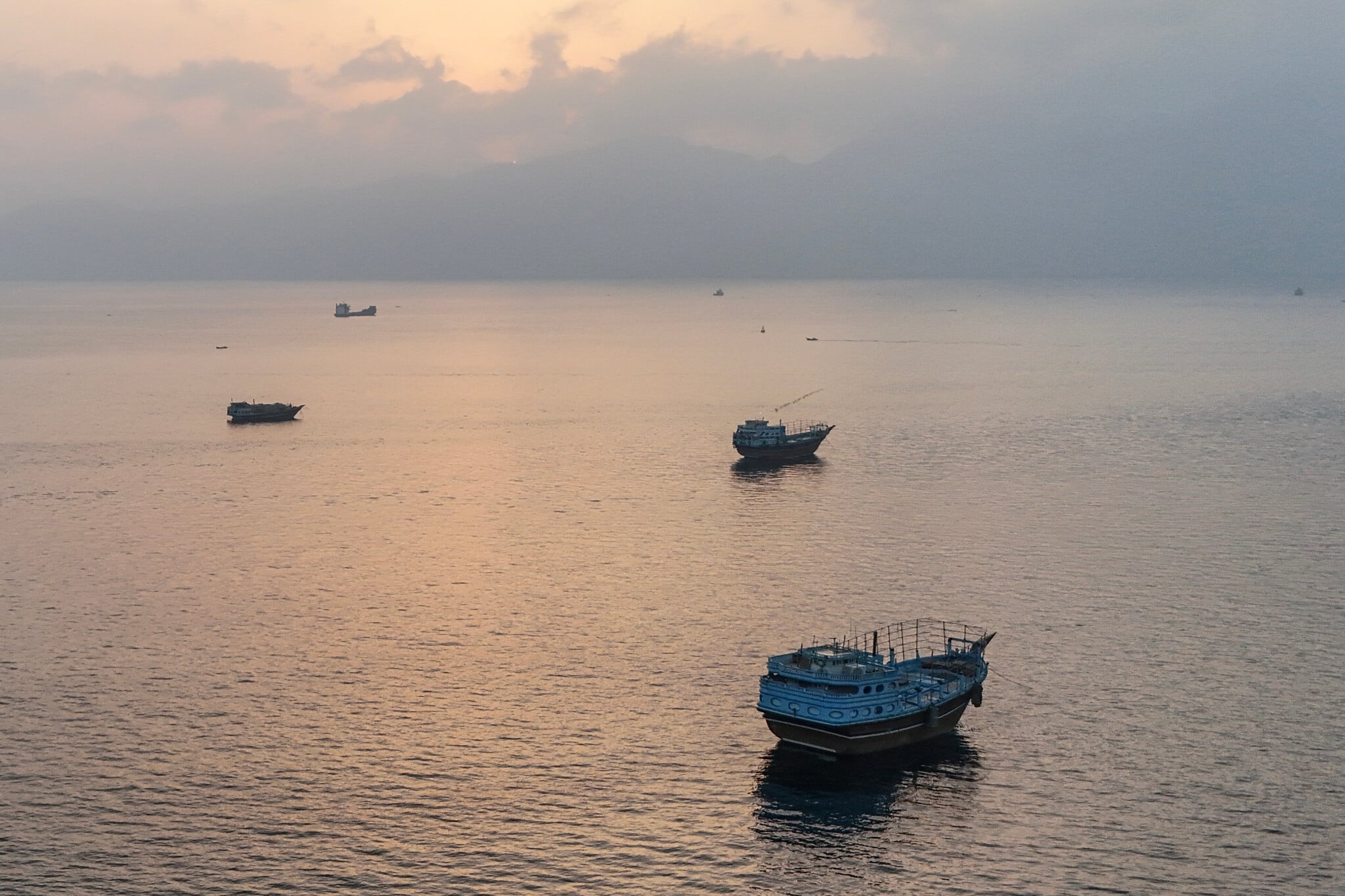
This aerial photograph shows boats anchored off Oman’s northern Musandam Peninsula near the Strait of Hormuz on June 27, 2026. (AFP)
Iran and the United States have agreed to halt attacks, a US official said Sunday, and will reportedly meet again on Tuesday in Doha to discuss the Strait of Hormuz.
The Axios news site, citing US officials and a source with knowledge of the details, reported that Tuesday’s talks were originally planned to take place in Switzerland, but the flareup caused them to be moved to Qatar’s capital and the topic was changed to the Hormuz standoff, as disputes and gaps remain despite the memorandum of understanding reached earlier this month.
“We decided to stop all the kinetic activity,” one of the US officials was quoted as saying.
Confirming that the sides agreed to stop attacks and resume negotiations, a US official said “technical talks are slated to continue on all areas of the MOU,” not just Hormuz.
“Both sides will stand down for now and vessels can move freely,” the official said.
The remarks came shortly after an Iranian official said Tehran did not take part in technical talks slated for Sunday due to recent attacks on the country and unfulfilled conditions of the MOU, which was meant to halt the fighting and reopen the strait while negotiations proceeded on issues such as Iran’s nuclear program.
“For example, one of the reasons is checking if we have access to the unfrozen funds; if there is no access then this condition has not been fulfilled,” Mehdi Fazaeili, a member of the Office of Preservation and Publication of the Works of Iran’s Supreme Leader, told state television.
Despite a ceasefire that took effect in April and the recently signed MOU, sporadic violence has continued in the Gulf region, the spark of which is often Iranian attacks on ships passing through the Strait of Hormuz.
Tehran was angered by Oman’s announcement last week of an alternative route through the strait that hugged the Omani shoreline, which Muscat said was set in conjunction with the International Maritime Organization.

Iran has continued to insist on controlling passage through the vital strait, through which a fifth of the world’s oil and liquefied natural gas travel in normal times. It did not enjoy such control before the war.
The strait comprises Omani and Iranian territorial waters, but under customary international law the two cannot generally block passage or charge tolls.
Nevertheless, Iran prevented most ships from using the narrow waterway during the war, granting it enormous economic leverage, which it appears reluctant to give up.
The attacks by Iran to enforce its control have triggered repeated tit-for-tats with Washington, the latest of which came early Sunday, when US Central Command said it had attacked 10 Iranian military targets over “continued Iranian aggression against commercial shipping” following another strike on a tanker in the region.
Iran’s Islamic Revolutionary Guard Corps said it retaliated with strikes against US bases in Kuwait and Bahrain, which both of those countries condemned. The IRGC claimed the US strikes violated the ceasefire and “will result in the complete halt of all diplomatic processes,” state-run Press TV said. The IRGC navy command said American bases in the region “will experience hell in the coming days.”
‘Hegemonic dreams’
Iran presently insists ships transiting the strait pass through a corridor near its own shores, though this week dozens of vessels have travelled along the opposite side of the waterway, hugging the Omani coast.
“Any attempt to adopt new or separate arrangements compared to what is underway by the Islamic Republic of Iran will only lead to more complicated situations and delays in the reopening of the Strait of Hormuz, and will increase the tensions,” Iranian Foreign Minister Abbas Araghchi said.
The published text of the memorandum says Iran will define the future administration of the strait in dialogue with Oman and the other Gulf States, but “in line” with international law.

Meanwhile, Iran’s Islamic Revolutionary Guard Corps said it was taking measures to control traffic in the strait and that vessels violating them would be dealt with more firmly than before.
Mohammad Mokhber, adviser to Iran’s supreme leader, wrote on X that as long as Iran managed the strait, Washington’s “hegemonic dreams in the region will not be realized.”
Experts said there would likely be more Hormuz incidents.
For Iran, “a drawn-out negotiation accompanied by controlled pressure in the strait can work to its advantage,” said HA Hellyer of Royal United Services Institute, a London think tank.
While the exchanges have largely been without reported casualties, Qatar’s interior ministry said one of its citizens was killed aboard a boat by shrapnel from “military operations in the area,” without providing further details.
The deceased was found Sunday after his boat failed to return to port on Saturday as expected.
About The Author
