As Hamas rebuilds, Israel faces the same unresolved question: what comes after the fighting ends?

Smoke rises from a fire, following an Israeli strike on a tent camp sheltering displaced Palestinians, earlier this year.(photo credit: Dawoud Abu Alkas/Reuters)ByYAAKOV KATZMAY 8, 2026 09:18
Is war returning to Gaza? That is the question being quietly debated inside Israel’s security establishment.
In the IDF Southern Command, for example, senior officers are adapting and redrafting operational plans for a renewed offensive, including conquering the part of Gaza not currently under Israeli control.
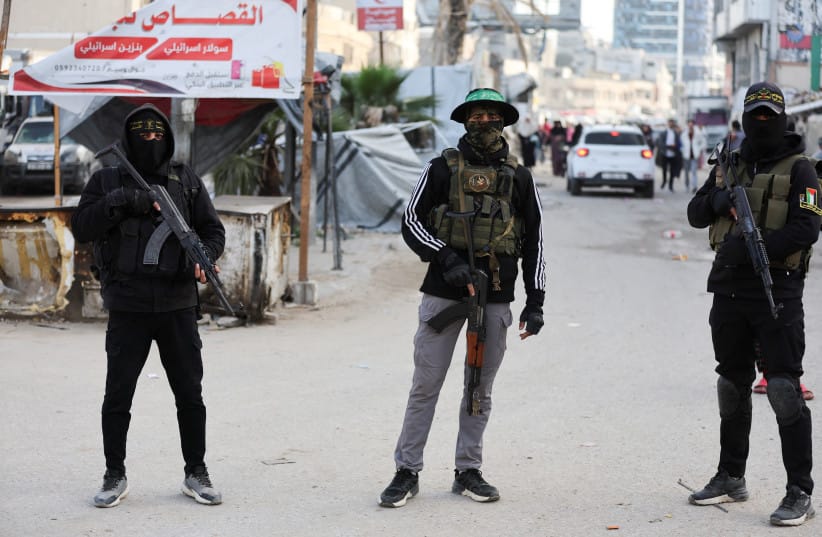
And the reason is simple: Hamas is back. Not in the sense that it can immediately launch another October 7-style attack against Israel – the IDF still maintains control over significant parts of the Strip, including the buffer zone and the “yellow line” established after the war – but it is rebuilding, reconstituting itself and rearming.
Talk to commanders who have spent time in Gaza in recent months, and they all describe the same picture: Hamas operatives are openly moving around, humanitarian routes are being used to try to smuggle in weapons, terror infrastructure is slowly being rebuilt, and the organization is once again tightening its grip over the civilian population. Its finances, depleted during the war, are also recovering. Fear – Hamas’s most powerful weapon against Gazans themselves – is back.
Hamas did not build the capabilities for the October 7 massacre in just a year or two. It took decades. First came rudimentary rockets. Then, the longer-range rockets. Then tunnels. Then, precision explosives. Then, the elite infiltration units. Israel watched much of it happen in real time and convinced itself it could contain the threat, an illusion that was shattered on October 7.
Now Israeli officials fear the same cycle may already be restarting because the dilemma facing Israel is not simple. The first option is to return to war – to launch another massive ground invasion, reconquer the remaining areas of Gaza, and attempt once again to dismantle Hamas completely.
The problem is that Israel already tried this. For two years, the IDF operated in Gaza with the objective – as delineated by the prime minister – to destroy Hamas.
Extraordinary military force was employed, thousands of terrorists were killed, and almost the entire leadership was decapitated. Yet Hamas survived. Why would trying the same thing again yield a different result?
The second option is to avoid another war and try to manage the situation – maintain the status quo, work alongside the “Board of Peace” led by US President Donald Trump, deepen regional cooperation, and hope that eventually enough diplomatic and economic pressure will force Hamas to disarm and relinquish control.
Maybe that works. Maybe it does not.
For now, we know that Hamas refuses to disarm and that, as long as this is the case, the Board of Peace will not advance other Gaza reconstruction initiatives. But that is fluid, and over time, the demands on Israel will almost definitely shift. Pressure will mount to scale back operations, then it will be to scale back the presence of forces, and then it will be to leave the Gaza Strip completely.
There is another problem as well – if Israel restarts the war, much of the world will not understand why. From the outside, the ceasefire and the return of the hostages created the perception that the war was over. If Israel suddenly launches a new offensive, many will not understand why and will view it as unprovoked Israeli aggression.
The reason is that there has not been any serious public diplomacy campaign. No systematic effort to educate allies or international audiences about Hamas’s reconstitution, and no clear explanation why Israeli commanders believe time is again working in Hamas’s favor.
This situation, though, touches on a deeper issue – how did Israel even find itself here?
How is it possible that after the deadliest massacre of Jews since the Holocaust, after two years of war against the organization responsible, Hamas still exists and still controls half of Gaza?
Military force alone will not defeat Hamas
Part of the answer lies in a truth many Israelis continue to struggle to accept: military force cannot alone solve our problems. While military force is essential, and there was never a more legitimate war than the one after October 7, wars are not won only by force. They also require a political strategy.
Here is just one small example: Early in the war, Israeli forces seized Shifa Hospital, uncovering tunnels, command centers, and evidence that hostages had been held beneath and inside the facility. Hamas fighters were eliminated, and the area was cleared.
Then, months later, we awoke one morning to the news that Israeli forces had surrounded Shifa, where about 1,000 terrorists had taken refuge. It didn’t make sense. Just a few months ago, it was empty. How did it suddenly return to being a terrorist refuge?
The answer was that while Israel cleared the area militarily, it left a vacuum, refusing consistently throughout the war to work with any alternative entity that could control Gaza. And in the Middle East, vacuums do not remain empty for long. Hamas filled it again.
That pattern repeated itself throughout the war – Israel would enter an area, dismantle terror infrastructure, withdraw, and then watch Hamas slowly return.
To some extent, the same thing happened in Lebanon. Israel fought Hezbollah, agreed to a ceasefire in November 2024, and assumed deterrence would hold. But there was no broader political architecture established afterward. No alternative mechanism. Then, after the war with Iran broke out at the end of February, Hezbollah resumed firing rockets into Israel once again.
Even with Iran, when the recent war was over, the Israeli public largely felt like the country had failed, despite most of the defense establishment viewing the operation as a significant military success
The reason was that the moment the fighting transitioned into diplomacy and ceasefire negotiations, the Israelis lost confidence. If force did not get the Iranian regime to give up its uranium, then why would negotiations?
And that may be one of the deepest strategic problems Israel faces today: there is no belief in political processes.
There are a number of factors behind this, but one of them is that Israelis are deeply traumatized by the failure of what was the last political process to try and end our longest conflict – the Oslo Accords.
While peace with Jordan was reached after the Oslo Accords were signed in 1993, this agreement with the Palestinians is remembered as such a failure that it impacts Israelis’ ability to consider political agreements as pathways to stability.
That disenchantment is what shapes the nation’s approach to war and is why Israeli discourse revolves almost exclusively around phrases like “total victory,” “crushing the enemy,” and “victory for generations.” The language is always military, and the solutions are always military.
But if October 7 taught Israel anything, it should be that military force alone cannot sustainably solve these conflicts.
Yes, Israel must remain powerful, must act preemptively against emerging threats, and must be prepared all the time to deploy military force, but after so many years of war, it should be obvious that military power by itself does not create political reality.
And unless Israel begins to think seriously about what follows the fighting – in Gaza, Lebanon, Syria, and beyond – it may continue winning battles while repeatedly finding itself dragged back into the same wars.
The writer is a co-founder of the MEAD policy forum, a senior fellow at JPPI, and a former editor-in-chief of The Jerusalem Post. His latest book is While Israel Slept.
About The Author
