Trump to meet with national security, foreign policy teams to discuss proposal, report says, as oil prices rise after failed attempt to restart negotiations over the weekend
By ToI Staff and AgenciesToday, 10:03 am
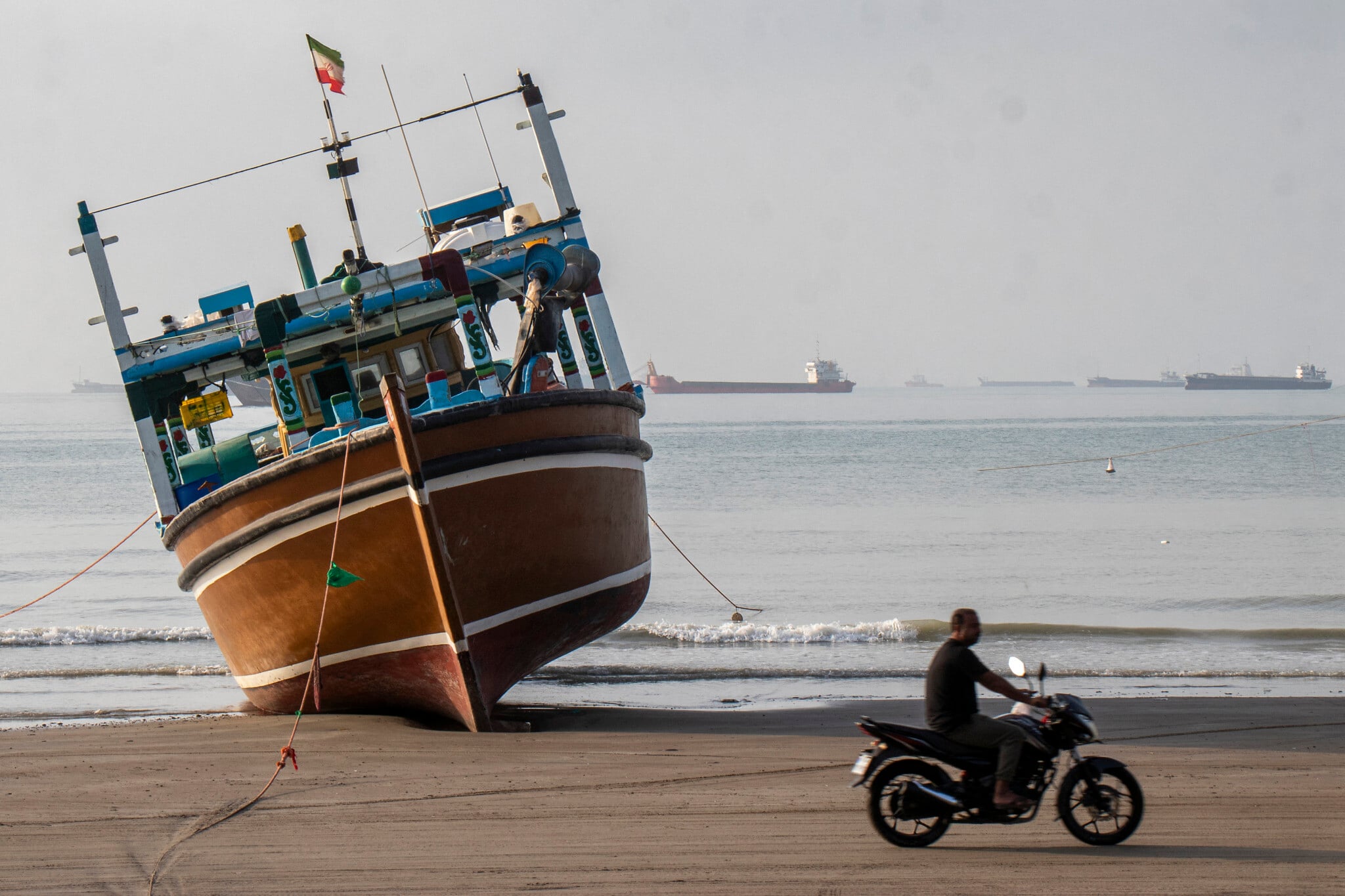
In this picture obtained from Iran’s ISNA news agency on April 24, 2026, an Iranian man rides his motorcycle past a boat at Suru Beach in Bandar Abbas along the Strait of Hormuz. (Razieh Poudat/ISNA/AFP)
Iran has proposed a deal with the United States to reach an agreement on reopening the Strait of Hormuz and ending the war, while delaying negotiations on Tehran’s nuclear program to a later stage, according to a report Sunday, after hoped-for talks in Pakistan over the weekend failed to materialize.
The Axios report, citing a US official and two sources familiar with the matter, was published as Iranian Foreign Minister Abbas Araghchi briefly returned to Islamabad after visiting Oman on Saturday, despite US President Donald Trump signaling that he did not plan to dispatch a negotiating team anytime soon.
Instead, after calling off a planned delegation to Pakistan at the last minute the previous day, the president said on Sunday that the Iranian team could reach Washington by phone if they wished to speak, and Araghchi departed Pakistan again, this time headed for Russia.
According to Axios, Iran’s attempt to kickstart negotiations again by solving the issues centered on the Strait of Hormuz was conveyed to the US by Pakistani mediators.
The strait — the narrow mouth of the Persian Gulf through which a fifth of all traded oil and natural gas passes — has been at the center of a standoff ever since a ceasefire between Iran and the US and Israel entered into effect on April 8, as Iran has restricted movement through it and the US imposed a blockade of Iranian ports.
Trump was expected to discuss the Iranian proposal and other issues held up in the stalled negotiations during a Situation Room meeting with national security and foreign policy teams on Monday, Axios said.
But resolving the standoff over the Strait of Hormuz, lifting the US blockade and allowing Iran’s oil exports to flow again would leave Trump and Washington without much leverage for future negotiations.

It is also unclear whether Trump would agree to push off the nuclear talks to an unspecified later date, given that he has repeatedly insisted that he will settle for nothing less than Tehran’s commitment to ending its nuclear activities.
The status of Iran’s enriched uranium has long been at the center of tensions. Tehran has 440 kilograms (970 pounds) of uranium enriched to 60 percent purity, a short, technical step from weapons-grade levels, with no peaceful application.
Israel, which has not been involved in the negotiations in Pakistan, has also insisted that the US must put an end to Tehran’s nuclear ambitions as part of any deal to end the fighting.
Araghchi drops by Russia
Meanwhile, Iran’s top diplomat landed in St. Petersburg on Monday for the final leg of his regional tour.
Iranian state media reported that Araghchi would meet with Russian President Vladimir Putin and other Russian officials to discuss bilateral ties and regional issues, including the war.
Araghchi said the consultations in Pakistan over the weekend had reviewed conditions under which Iran-US talks could resume, stressing that Tehran would seek to secure its rights and national interests following weeks of conflict.

He made no mention of the reported proposal to push off nuclear negotiations for the time being in favor of focusing on the Strait of Hormuz.
He said, though, that Iran and Oman, as coastal states of the strait, had agreed to continue expert-level consultations to ensure safe transit and protect shared interests in the waterway.
Tehran is hoping to persuade Oman to support a mechanism to collect tolls from vessels passing through the strait, according to a regional official who spoke to The Associated Press on condition of anonymity because he was not authorized to discuss the matter.
Oman’s response wasn’t immediately clear.
The official, who is involved in mediation efforts, also said Iran is insisting on ending the US blockade before a new round of talks on the remaining issues begins — apparently giving credence to the Axios report, albeit from a different perspective. They said Pakistani-led mediators were trying to bridge significant gaps between the countries.
Araghchi also spoke by phone with counterparts in Qatar and Saudi Arabia on Sunday.
Oil prices rise as hope dims
But his attempts to muster support for resolving the crisis in the strait appeared to have little effect, as oil prices were up more than 1% on Monday, with benchmark Brent crude futures rising $1.35, or 1.3%, to $106.68 a barrel, retreating from early session gains of over $2 a barrel.
US West Texas Intermediate was at $95.35 a barrel, up 95 cents, or 1%.
Brent and WTI gained nearly 17% and 13%, respectively, the biggest weekly gains since the start of the war, last week, before hopes of reviving peace talks receded over the weekend.
Oil prices have risen steadily since Israel and US launched the opening strikes of the war on February 28, and tankers full of crude became stranded in the Persian Gulf, unable to safely transit through the Strait of Hormuz.
Even with a fragile truce having paused the direct fighting between the warring sides, the economic fallout of the war is still growing, as global shipments of oil, liquefied natural gas, fertilizer and other supplies are disrupted by the near-closure of the strategic strait.

Both sides have also continued to make military threats. Iran’s joint military command Saturday warned that “if the US continues its aggressive military actions, including naval blockades, banditry, and piracy,” it will face a “strong response.”
Trump last week ordered the military to “shoot and kill” small boats that could be placing mines in the waterway.
He told journalists on Saturday, before a security incident at the White House Correspondents’ Dinner, that within 10 minutes of his cancelling his envoys Steve Witkoff and Jared Kushner’s trip to Islamabad, Iran sent a “much better” proposal.
He did not elaborate but stressed again that one of his conditions is that Iran “will not have a nuclear weapon.”
About The Author
